A great-looking front yard doesn’t require a landscape architect’s budget or a crew of professionals. Most homeowners can dramatically improve curb appeal with a weekend’s work and a few hundred dollars in materials. The key is choosing projects with high visual impact and low ongoing costs, perennials instead of annuals, DIY pathways instead of contractor-installed pavers, and strategic focal points that draw the eye without draining the wallet. This guide walks through fifteen practical, budget-conscious landscaping ideas that deliver professional-looking results.
Table of Contents
ToggleKey Takeaways
- Budget-friendly curb appeal front yard landscaping thrives on perennials instead of annuals, which return yearly and multiply over time while saving $3–$5 per season per plant.
- DIY pathways and borders—whether gravel ($35–$50), stepping stones ($2–$4 each), or salvaged bricks ($0.25–$0.50 each)—add structure and polish without contractor costs of $8–$12 per linear foot.
- Fresh mulch and strategic focal points like painted mailboxes, oversized planters, and solar lighting transform curb appeal visually for minimal investment while suppressing weeds and retaining soil moisture.
- Native perennials adapted to your climate require less water, fertilizer, and maintenance, making them the backbone of any low-cost, sustainable front yard design.
- Consistent maintenance—weekly weeding, twice-yearly edging, and seasonal refreshes—preserves your landscaping investment and prevents a polished yard from appearing neglected.
Start with Strategic Plant Selection
Plant selection is where most front yard budgets either balloon or stay manageable. The temptation to fill beds with flats of colorful annuals fades fast when the credit card bill arrives. Smart plant choices pay dividends year after year.
Perennials Over Annuals for Long-Term Savings
Perennials return every spring, making them the backbone of any budget landscape. A single $12–$15 perennial like black-eyed Susan, coneflower, or daylily multiplies over three to four years, eventually filling a two- to three-foot diameter space. Compare that to annuals that need replacing every season at $3–$5 per plant.
Focus on native perennials adapted to the local climate. They require less water, fertilizer, and pest management than exotic imports. For example, in USDA Zone 5–7, Russian sage, catmint, and sedum thrive with minimal intervention. In southern zones, lantana and salvia handle heat and drought without coddling.
Buy smaller container sizes (1-gallon pots instead of 3-gallon) to stretch the budget further. Plants catch up within a season, and the price difference can be $10–$15 per plant. Shop end-of-season sales at nurseries, late August and September often bring 50% markdowns on healthy perennials.
Group plants in odd-numbered clusters (threes, fives, sevens) for visual impact without buying dozens. A tight grouping of five identical plants reads as intentional design, not sparse planting. Leave space between clusters for mulch, which we’ll cover shortly.
Don’t overlook modern landscaping ideas that incorporate grasses like fountain grass or blue fescue. Ornamental grasses are budget-friendly, low-maintenance, and add movement and texture that perennials alone can’t match.
Define Your Space with DIY Pathways and Borders
Defined edges and pathways separate a polished landscape from an undefined yard. Installing them yourself saves the $8–$12 per linear foot that contractors charge for edging.
Gravel pathways are the most budget-friendly option. A 3-foot-wide, 20-foot-long path requires roughly 1 cubic yard of 3/4-inch crushed stone (about $35–$50 delivered). Dig out 3–4 inches of soil, lay landscape fabric to suppress weeds, and spread the gravel. Tamp it down with a hand tamper or the flat side of a garden rake. Edge with steel or aluminum landscape edging ($1.50–$2.50 per linear foot) to keep gravel contained.
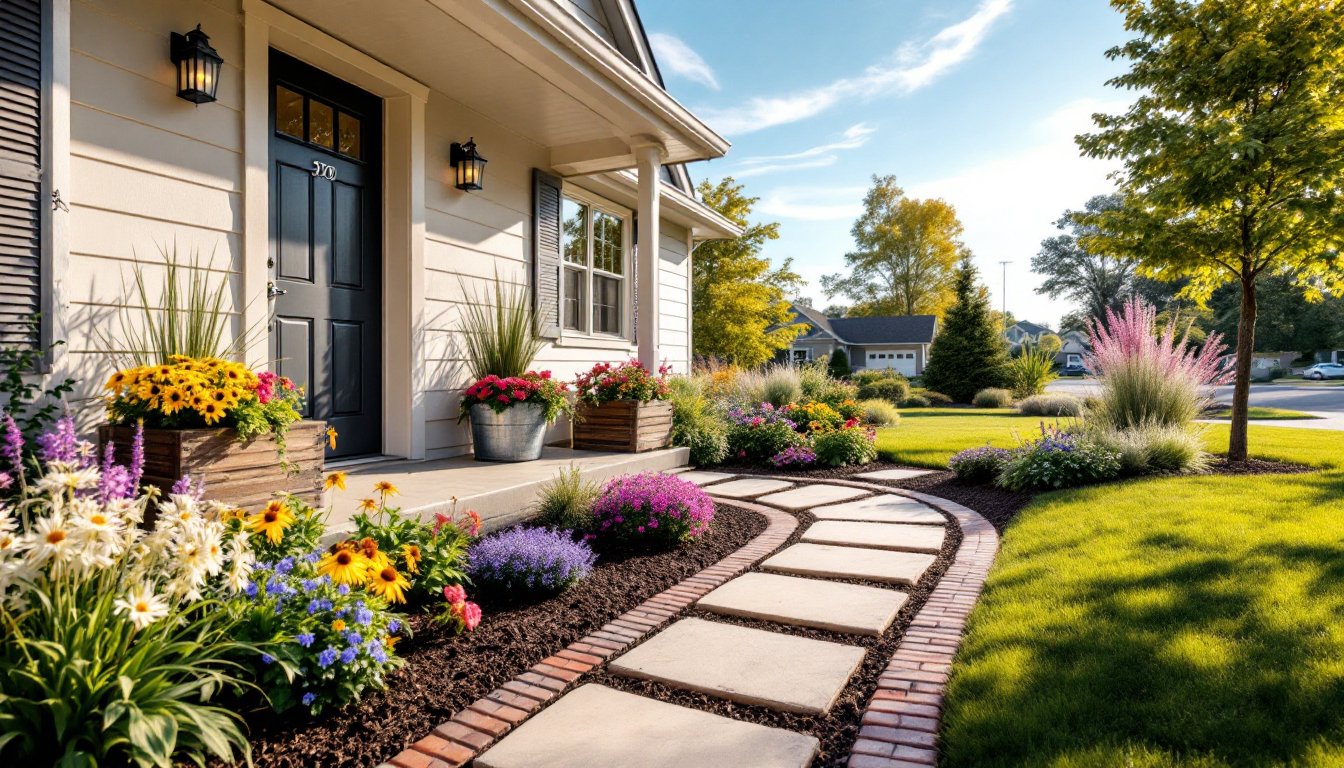
For a more formal look, consider stepping stone paths. Use 12-inch or 16-inch concrete pavers ($2–$4 each at home centers) spaced 18–24 inches apart. Dig out grass to the paver’s thickness, add a 1-inch sand base, and set pavers level. Fill gaps with mulch or groundcover like creeping thyme.
Brick or stone borders around planting beds add instant structure. Salvaged bricks from demolition yards or online marketplaces often cost $0.25–$0.50 each, far less than new pavers. Lay them on edge in a shallow trench for a classic look. No mortar needed for informal beds.
If working on small house front yard projects, keep pathways narrow (30–36 inches) to maximize planting area without sacrificing functionality.
Add Personality with Upcycled and Repurposed Decor
Curb appeal doesn’t have to be cookie-cutter. Upcycled elements add character at a fraction of retail prices.
Vintage planters from thrift stores, estate sales, or online marketplaces make excellent focal points. An old galvanized wash tub, wooden crate, or ceramic urn costs $5–$20 and holds far more visual interest than a plastic pot. Drill drainage holes in the bottom if they’re not present, use a 1/2-inch masonry bit for ceramic or metal.
Repurposed wood works for DIY plant stands, trellises, or arbor accents. Pallet wood is often free from warehouses or small manufacturers (call ahead, many are happy to offload them). Sand rough edges, apply exterior stain or paint, and assemble simple structures with 2-1/2-inch deck screws. A basic A-frame trellis for climbing roses or clematis takes less than an hour to build.
Painted rock borders are a zero-cost project if you have stones on-site. Collect 4–6-inch diameter rocks, scrub them clean, and paint with exterior acrylic paint in colors that complement the house. Line walkways or beds with them.
According to Gardenista’s curb appeal guide, small upgrades like house numbers, mailbox refreshes, and painted front doors yield outsized visual returns for minimal cost.
Safety note: When cutting reclaimed wood, wear safety glasses and a dust mask. Old lumber may contain nails, splinters, or lead paint.
Maximize Impact with Mulch and Ground Cover
Nothing transforms a front yard faster or cheaper than a fresh layer of mulch. It suppresses weeds, retains moisture, and provides a clean, finished backdrop for plants.
Shredded hardwood mulch is the workhorse choice, running $25–$35 per cubic yard from landscape suppliers (significantly cheaper than bagged mulch at $4–$6 per 2-cubic-foot bag). A cubic yard covers roughly 100 square feet at a 3-inch depth, the standard for weed suppression and moisture retention.
Spread mulch in spring after soil warms, or in fall for winter protection. Pull it back 2–3 inches from plant stems and tree trunks to prevent rot and pest issues. Don’t pile mulch against siding or foundation walls, moisture trapped against wood invites carpenter ants and decay.
For high-traffic or sloped areas where mulch washes away, consider small rocks for landscaping instead. Pea gravel or 3/8-inch river rock stays put, doesn’t decompose, and costs $35–$50 per cubic yard. It’s also ideal around downspouts and drainage areas.
Living ground covers like creeping Jenny, ajuga, or vinca minor fill bare spots under trees or in shaded areas where grass struggles. They’re sold in flats (often 18–32 plants per flat) for $20–$30. Space plugs 8–12 inches apart: they’ll knit together in one to two seasons. This approach is especially useful for low-maintenance landscaping ideas that reduce mowing and weeding.
Pro tip: Many municipalities offer free mulch made from chipped tree trimmings. It’s usually available for self-pickup and works fine for general beds, though it’s less uniform in color than commercial mulch.
Create Focal Points Without Breaking the Bank
A well-placed focal point anchors the design and draws attention away from less-polished areas of the yard.
DIY mailbox upgrade: A fresh coat of paint and new house numbers instantly modernize an entry. Use exterior semi-gloss paint for durability and clean the surface with TSP (trisodium phosphate) before painting. Swap basic numbers for modern 4–6-inch brushed nickel or matte black numbers ($15–$25 for a set). Mount them directly on the house or mailbox post with appropriate fasteners.
Oversized planters flanking the front door create symmetry and polish. Build your own from cedar fence pickets (about $3–$5 each) cut and assembled into 16-inch or 18-inch cubes. Line the interior with landscape fabric to prevent soil contact with wood, which extends longevity. Fill with a mix of upright plants (like cordyline or ornamental grass) and trailing plants (like sweet potato vine or ivy) for layered interest.
Lighting is often overlooked but makes a massive difference at dusk. Solar path lights have improved dramatically and now offer decent illumination for $8–$15 per fixture. Space them 6–8 feet apart along walkways. For accent lighting on trees or architectural features, low-voltage LED spotlights start around $20–$30 per fixture and connect to a simple plug-in transformer.
Vertical interest adds dimension. A simple DIY obelisk or tuteur made from 1×2 furring strips ($2–$3 per 8-foot length) provides structure for annual vines like morning glory or black-eyed Susan vine. Stain or paint them to match trim color.
Design inspiration from HGTV’s landscaping gallery shows how focal points work in various front yard layouts and styles.
Maintain Your Landscape for Lasting Curb Appeal
Budget landscaping fails when maintenance is ignored. A $300 investment in plants and mulch looks like $3,000 when kept tidy, or $30 when neglected.
Edging is the single most important maintenance task. Use a half-moon edger or flat spade to redefine bed lines twice per year, spring and late summer. Clean edges make the difference between polished and sloppy, even if the plants inside are modest.
Weeding takes 15 minutes per week if done regularly, or hours per month if delayed. Pull weeds when soil is moist (after rain or watering) so roots release cleanly. A hori-hori knife or dandelion weeder ($12–$18) makes quick work of tap-rooted weeds in beds and cracks.
Pruning keeps shrubs in bounds and encourages healthy growth. Most foundation shrubs need shaping once or twice per year. Use bypass pruners (not anvil-style, which crush stems) and make cuts just above a leaf node or bud at a 45-degree angle. Don’t shear shrubs into balls or boxes unless that’s the intended style, natural form usually looks better in front yards.
Seasonal refreshes keep interest year-round. Swap out a few containers with cool-season annuals (pansies, ornamental kale) in fall, or add evergreen boughs and birch branches to winter planters for texture.
Watering is critical in the first growing season. New perennials and shrubs need consistent moisture, roughly 1 inch per week from rain or irrigation, until roots establish. After that, most natives and adapted perennials are drought-tolerant. A soaker hose ($15–$25 for 50 feet) laid through beds and covered with mulch delivers water directly to roots with minimal waste.
For proper landscaping around house foundation, ensure drainage slopes away from the home and avoid plants that require frequent watering near the foundation.
Consider simple front of house designs that reduce long-term upkeep while maintaining visual appeal.