Most homeowners put off front yard landscaping because they think it requires weeks of labor and a contractor’s budget. It doesn’t. With a strategic plan and a weekend’s worth of work, anyone can transform a tired front lawn into an eye-catching entry that boosts curb appeal and property value. The key is choosing projects that deliver maximum visual impact without demanding specialized skills or ongoing maintenance. This guide walks through seven approachable landscaping strategies that use readily available materials, require minimal upkeep, and produce results that look professionally installed.
Table of Contents
ToggleKey Takeaways
- Easy landscaping ideas for front yards can be completed in a weekend without contractor budgets by using strategic planning and readily available materials.
- Mulch and ground cover plants suppress weeds, retain moisture, and require minimal maintenance while transforming bare soil into finished-looking beds.
- Clean landscape edging and simple pathways create a professional appearance that prevents mulch migration and grass creep for lasting curb appeal.
- Container gardens and potted plants offer instant color and height without permanent commitment, making them ideal for quick visual impact.
- Native plants and shrubs adapted to your region require less water and maintenance while providing year-round interest through foliage, blooms, and berries.
- Symmetrical plantings at entryways and strategic use of rock accents signal intention and polish, even when combined with simple hardscape elements.
Start with Low-Maintenance Ground Cover and Mulch
Bare soil doesn’t just look unfinished, it invites weeds, erodes in rain, and dries out plants faster. Organic mulch solves all three problems and gives any yard an instant upgrade.
Use shredded hardwood bark or pine bark nuggets at a depth of 2–3 inches around plantings and trees. Both suppress weeds, retain moisture, and break down slowly to feed the soil. Avoid piling mulch against tree trunks or home foundations: leave a 2-inch gap to prevent rot and pest issues.
For areas where grass struggles, under trees, along fences, or on slopes, consider replacing turf with ground cover plants like creeping thyme, vinca minor, or pachysandra. These spread naturally, require no mowing, and stay green with minimal water once established. When planting ground cover around house foundation, ensure proper drainage away from the structure.
One cubic yard of mulch covers roughly 100 square feet at 3 inches deep. Most home centers sell it in 2-cubic-foot bags, which means you’ll need about 13–14 bags per 100 square feet. Buying in bulk from a landscape supplier cuts cost significantly if the project area exceeds 200 square feet.
Create Defined Borders with Edging and Pathways
Clean edges are what separate amateur yards from professional-looking landscapes. Without defined borders, mulch migrates onto walkways, grass creeps into beds, and the whole project looks sloppy within a month.
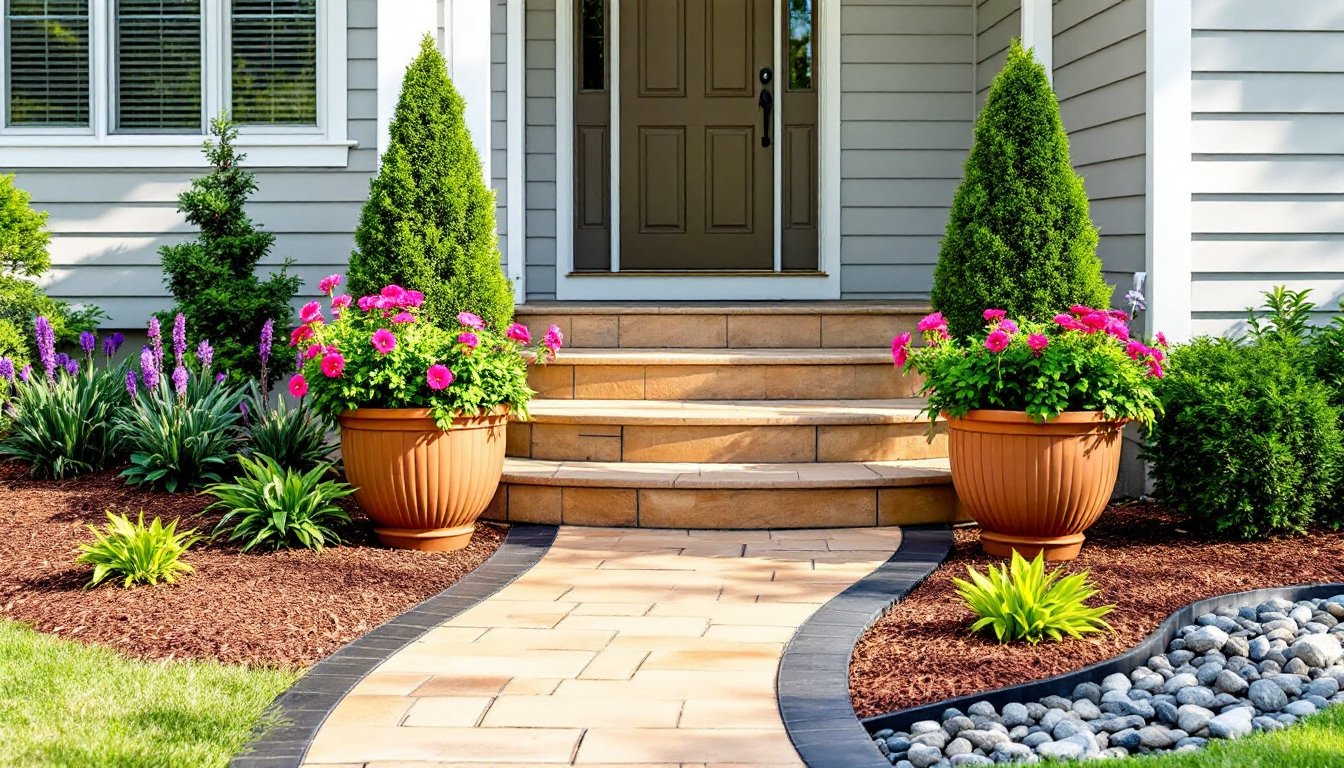
Plastic or metal landscape edging installs quickly and holds mulch in place for years. Steel edging offers the sharpest lines and lasts indefinitely, but costs more. For a budget-friendly option, poly edging (the black ribbed kind) works fine, just stake it every 3–4 feet so frost heave doesn’t lift it.
If edging feels too industrial, try natural stone or brick borders. Set pavers vertically halfway into the soil along bed edges, or lay them flat and mortarless for a cottage-style look. Keep the top of the border flush with or slightly above the lawn to make mowing easier.
Pathways add function and flow. A simple gravel path (¾-inch crushed stone over landscape fabric) costs less than $2 per square foot and drains beautifully. For a more solid surface, use stepping stones spaced 18–24 inches apart, close enough for a comfortable stride. Embedding them flush with the lawn lets a mower roll right over them.
Add Instant Color with Container Gardens and Potted Plants
Containers are the fastest way to inject color and height into a front yard without committing to permanent plantings. They’re also forgiving, if a plant fails or the look feels off, swap it out.
Choose pots that are at least 12–16 inches in diameter for outdoor use. Smaller containers dry out too quickly in sun and require daily watering. Resin or fiberglass planters mimic ceramic or concrete at a fraction of the weight and cost, and they won’t crack in freezing weather.
For sun-drenched entries, go with proven performers: geraniums, petunias, marigolds, and calibrachoa bloom nonstop from late spring through frost with weekly fertilizing. In shade, try coleus, impatiens, or begonias. Mixing in a thriller, filler, and spiller (tall centerpiece, mounding blooms, and trailing vine) creates depth without looking chaotic.
Use a quality potting mix, not garden soil, to ensure good drainage. Most containerized plants need water when the top inch of soil feels dry. In peak summer, that might mean daily watering for larger pots and twice daily for smaller ones.
Group containers in odd numbers (three or five) and vary heights for visual interest. Placing a tall planter beside the front door creates symmetry without requiring matching pairs.
Incorporate Native Plants and Shrubs for Year-Round Appeal
Native plants aren’t just trendy, they’re adapted to local soil and climate, which means less watering, fewer pest problems, and better survival rates than exotic imports.
Start by identifying a few native shrubs suited to the region. In many parts of the U.S., inkberry holly, winterberry, serviceberry, and ninebark offer multi-season interest with berries, fall color, or evergreen foliage. These typically mature at 4–8 feet tall, perfect for foundation plantings or corner anchors.
Perennial natives like black-eyed Susan, coneflower, bee balm, and aster bloom reliably and attract pollinators. Plant them in drifts of three or five for impact rather than dotting singles around the yard. Spacing depends on mature spread, check the plant tag and err on the generous side. Crowded perennials compete for light and air, leading to disease.
Many homeowners overlook the value of native grasses like little bluestem, switchgrass, or fountain grass. These add movement and texture, require zero fertilizer, and look sharp even in winter when dried seed heads catch snow and light.
When designing with natives, consider bloom time and foliage color so something’s always happening. Early bloomers (like wild columbine) give way to summer stalwarts (like Joe Pye weed), followed by fall stars (like goldenrod). For small yards, small front yard strategies help maximize plant diversity without overcrowding.
Use Decorative Rock and Gravel for Texture
Rock mulch isn’t just for xeriscaping. Used strategically, it provides contrast, reduces maintenance, and solves drainage issues that organic mulch can’t handle.
River rock (smooth, rounded stones ranging from 1–3 inches) works well around downspouts, in dry creek beds, or as a border between planting beds and hardscape. It doesn’t decompose, won’t blow away, and comes in shades from white quartz to charcoal. Lay landscape fabric underneath to prevent weeds: rock alone won’t stop them.
Pea gravel (¼–⅜-inch rounded stones) makes an excellent pathway surface or ground cover under benches and arbors. It’s walkable, drains instantly, and costs about $30–50 per cubic yard depending on region. The downside: it migrates. Use edging to keep it contained.
For a contemporary look, try crushed granite or decomposed granite (DG). DG compacts into a firm, permeable surface that feels almost like packed earth. It’s popular in modern landscapes and works beautifully with metal edging and modern plantings.
Avoid covering large areas with solid rock, it radiates heat in summer and offers zero soil improvement. Use it as an accent, not the main event. Combining rock with mulch and plants creates visual layers that make even simple landscapes feel thoughtfully designed.
Enhance Your Entryway with Symmetrical Plantings
Symmetry signals intention. When plants flank a front door or walkway in matching arrangements, the design feels polished even if the rest of the yard is casual.
The classic approach: two identical shrubs or topiaries on either side of the entry. Boxwood, dwarf Alberta spruce, or compact hollies hold their shape with minimal pruning and stay evergreen. For a less formal vibe, use matching containers with seasonal color instead of permanent plantings.
If the entry is off-center or the house lacks architectural balance, symmetry can correct it visually. Planting taller shrubs on the shorter side of an asymmetrical facade or adding a small tree near a blank wall draws the eye and evens things out.
Lighting amplifies symmetry at night. A pair of low-voltage path lights or uplights aimed at matching shrubs extends curb appeal past sunset. Most low-voltage kits run on a 12V transformer and install without an electrician, though burying the wire 6 inches deep (per NEC guidelines for low-voltage landscape cable) protects it from spade strikes.
Keep symmetrical plantings simple. Two well-maintained shrubs beat six mismatched, overgrown ones every time. If maintenance is a concern, many low-maintenance designs achieve symmetry with hardscape and containers rather than high-maintenance hedges.
Conclusion
Front yard landscaping doesn’t require a landscape architect’s budget or a contractor’s schedule. With the right combination of mulch, edging, containers, native plants, and rock accents, any homeowner can create a welcoming entry in a weekend. Focus on projects that suit the site’s sun, soil, and style, and remember that maintenance matters as much as installation. A few well-chosen, properly planted elements will outperform a complicated design every time.